
Veterinary Practice Special Feature · Evidence-led prescribing
Rethinking Parasite Control
Moving beyond routine treatment
Executive summary
- Growing environmental concerns and legislative inquiries are encouraging veterinary practices to move away from blanket anthelmintic treatments.
- Risk assessments predict exposure but do not reveal a pet's current parasitological status.
- Annual faecal testing combined with digital pre-consult risk profiles allows for targeted, evidence-led parasite control without overloading practice workflows.
The way veterinary practices approach parasite control is changing. Growing awareness of the environmental impact of antiparasitic medicines, combined with increasing emphasis on responsible prescribing, is encouraging the profession to move away from blanket treatment programmes and towards more targeted, evidence-led approaches. At the same time, the risks posed by parasites to animal welfare and public health remain significant. The challenge is not deciding whether parasite control should be tailored to the individual patient; it is finding a practical way to deliver that level of personalised care within the time and workflow constraints of modern veterinary practice.
Risk assessment is only part of the picture
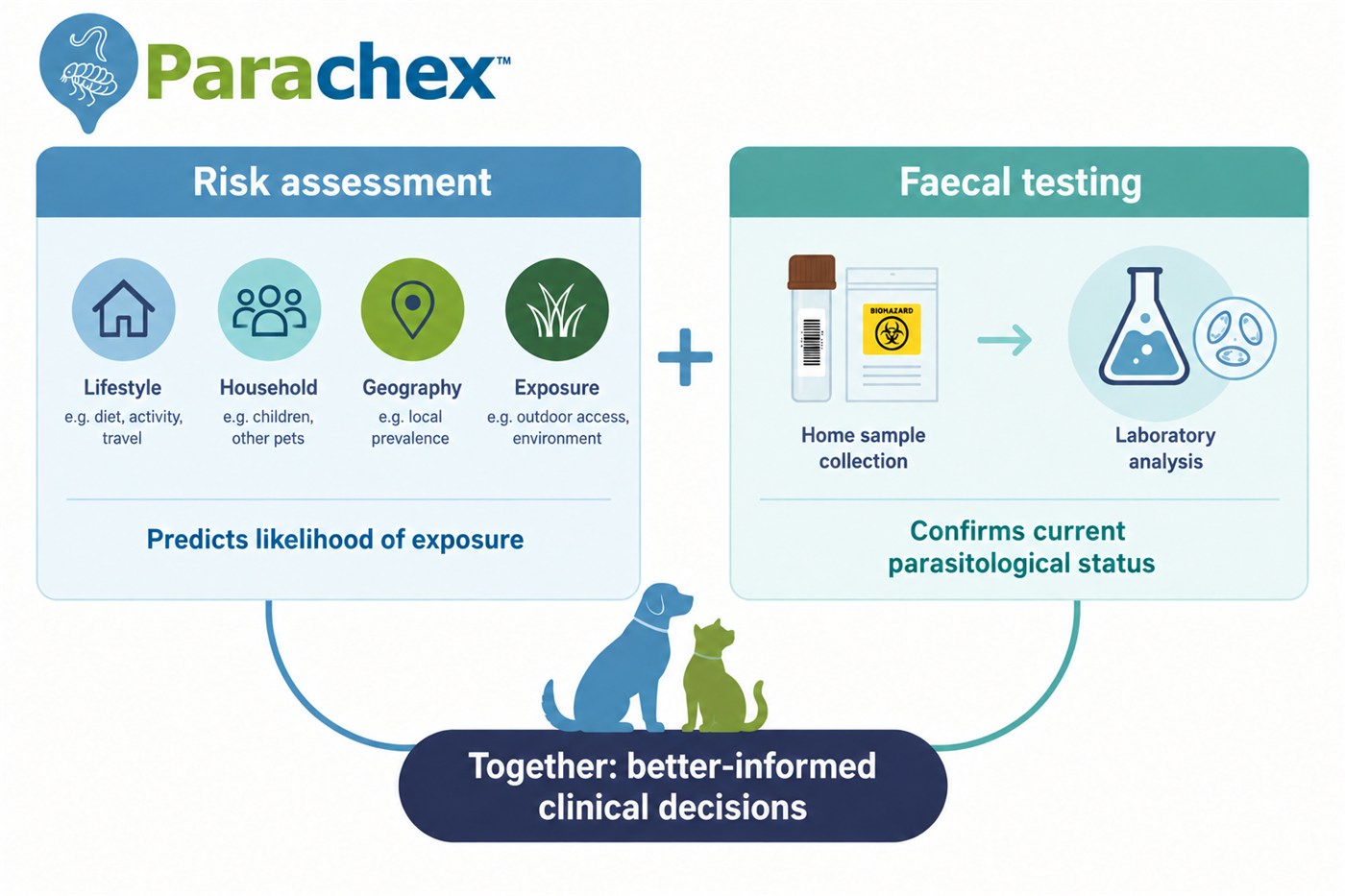
Parasite risk assessments are becoming an increasingly important part of clinical decision-making. Lifestyle, diet, household composition, environmental exposure and local parasite prevalence all influence a patient's level of risk. However, risk assessments are inherently predictive. They help estimate the likelihood of exposure but do not provide evidence of a patient's current parasitological status.
This distinction has become ever more relevant following the recent House of Lords Environment and Climate Change Committee inquiry into pet parasite medications, which highlighted concerns around environmental contamination and called for a more precautionary approach to antiparasitic use where treatment may be unnecessary.
As expectations around parasite stewardship continue to evolve, veterinary teams are being asked to justify not only why a patient should receive treatment, but also when treatment may not be required.
Veterinary teams are being asked to justify not only why a patient should receive treatment, but also when treatment may not be required.
The role of annual faecal testing
ESCCAP guidance recognises regular faecal examination as an alternative to repeated routine anthelmintic treatment in appropriate circumstances, with treatment administered where diagnostic findings indicate a need. Current guidance also recommends that a thorough diagnostic examination should be carried out at least annually to determine parasitological status.
While this principle is straightforward, implementation is often more challenging. Collecting, processing and managing large numbers of faecal samples can place significant demands on practice teams. Cost considerations, sample logistics and consultation time pressures can all create barriers to widespread adoption.
| Challenge | Traditional approach | Targeted annual screening approach |
|---|---|---|
| Diagnostic evidence | None (presumption of infection) | Objective, annual lab diagnostic data |
| Environmental impact | Potential over-prescribing of active parasiticides | Reduced chemical shedding into ecosystems |
| Consultation time | 5-10 minutes spent discussing routine options | 1-2 focused minutes reviewing pre-generated results |
| Client compliance | Habitual/routine dosing | Higher engagement through clear diagnostic justification |
For many practices, annual faecal screening may represent a more practical starting point. When combined with a structured parasite risk assessment, annual testing provides objective diagnostic evidence that can support clinical decision-making without creating an unmanageable workload. Importantly, a single annual test is not intended to dictate a patient's parasite-control programme for the following 12 months. Instead, it provides an additional layer of information that can be considered alongside lifestyle risk factors and clinical judgement.
Making stewardship practical
The challenge is not simply generating more information; it is making that information usable within everyday practice. This is the thinking behind Parachex™, a parasite risk-assessment and screening service designed by vets, for vets, and delivered in collaboration with IDEXX.
Parachex™ combines a digital pre-consult parasite risk assessment with an at-home faecal collection kit, posted directly to owners ahead of their pet's annual booster appointments. Laboratory results and risk assessments flow straight back to the practice before the appointment, creating a seamless, data-ready consult without administrative bottlenecks.
The diagnostic component utilises the IDEXX Faecal Dx® panel, which screens for a range of clinically relevant intestinal parasites including roundworm, hookworm, whipworm, flea tapeworm (Dipylidium caninum) and Cystoisospora. The addition of the new taeniid tapeworm antigen accurately detects the presence of Taenia crassiceps, Taenia pisiformis, Taenia taeniaeformis, Echinococcus granulosus and Echinococcus multilocularis. This enables veterinary teams to develop targeted treatment and prevention plans.
Working with each practice or group, Parachex™ maps individual risk levels for core parasites to treatment schedules that have been agreed by the clinical team and aligned with the products stocked in the practice pharmacy. Rather than requiring the veterinary surgeon to build a parasite-control plan from scratch during every consultation, recommendations are generated in advance based on the patient's risk profile and diagnostic findings. This transforms what can often be a five-to-ten-minute discussion into a focused one-to-two-minute conversation, while still ensuring that the final clinical decision remains with the veterinary team.
At a glance · What the screen detects
IDEXX Faecal Dx® panel
- Roundworm
- Hookworm
- Whipworm
- Flea tapeworm (Dipylidium caninum)
- Cystoisospora
- New taeniid tapeworm antigen
- Taenia crassiceps
- Taenia pisiformis
- Taenia taeniaeformis
- Echinococcus granulosus
- Echinococcus multilocularis
Building confidence to prescribe more precisely
Perhaps the greatest opportunity offered by annual testing is not the diagnostic result itself, but the confidence it provides. Many veterinary teams recognise the value of risk-based prescribing but remain cautious about reducing treatment frequency without objective evidence. Regular screening helps bridge that gap.
As annual faecal testing becomes embedded within routine preventative healthcare, practices may gain greater confidence in replacing treatment with testing where risk assessment suggests this is appropriate. Rather than relying solely on theoretical risk, clinicians can incorporate both risk assessment and diagnostic evidence into their decision-making. The availability of broader diagnostic screening, including for tapeworm infections that have traditionally been difficult to identify through routine faecal testing, further increases the value of diagnostic evidence when discussing parasite prevention with owners.
Over time, this approach has the potential to support a gradual transition from treatment-led parasite control towards genuinely evidence-led prescribing, without compromising animal welfare or public health.
Putting the approach into practice
At Bishopton Veterinary Group, Parachex™ has been integrated into vaccination consultations and annual health-plan reviews. Ian McClive, Partner at Bishopton Veterinary Group, explains:
Case study · Bishopton Veterinary Group
"At Bishopton Vets we have embedded the Parachex™ parasite risk assessment tool into all vaccination consultations, complemented by annual faecal testing for our health-plan members. Having this information available before the consultation allows us to have more meaningful, evidence-based conversations with pet owners about parasite prevention.
We are already seeing a gradual reduction in overall parasiticide use while maintaining appropriate protection for pets and balancing animal health, human health and environmental considerations."
Partner, Bishopton Veterinary Group
Looking ahead
The future of parasite control is unlikely to be found at either extreme. Blanket treatment and blanket non-treatment both fail to account for the individual patient sitting in front of us. Instead, the profession is moving towards a model that combines risk assessment, diagnostic evidence and clinical judgement to support more proportionate prescribing decisions.
There is also an opportunity to build a stronger evidence base over time. As annual faecal screening becomes more widely adopted, practices will gain a clearer understanding of parasite prevalence within their own patient populations. This growing body of diagnostic information has the potential to further refine risk assessment and strengthen confidence in targeted prescribing approaches, including replacing treatment with testing where appropriate.
Parachex™ has been developed to help practices implement this approach in a practical, affordable and scalable way, combining digital risk assessment, annual faecal screening and practice-specific parasite-control protocols within existing clinical workflows.
Tailor Parachex™ to your practice
To discuss how Parachex™ can be tailored to your practice, get in touch.
support@petpointhealth.com